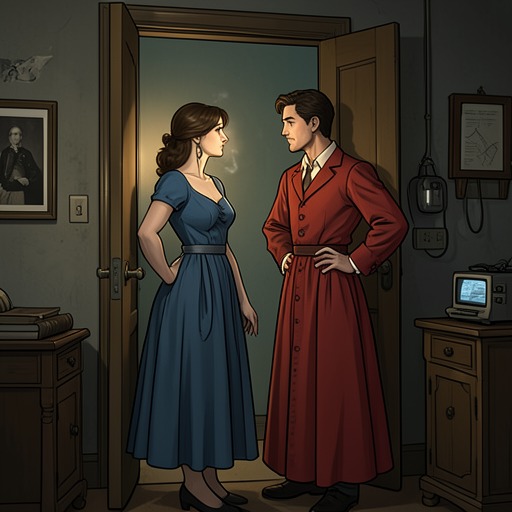
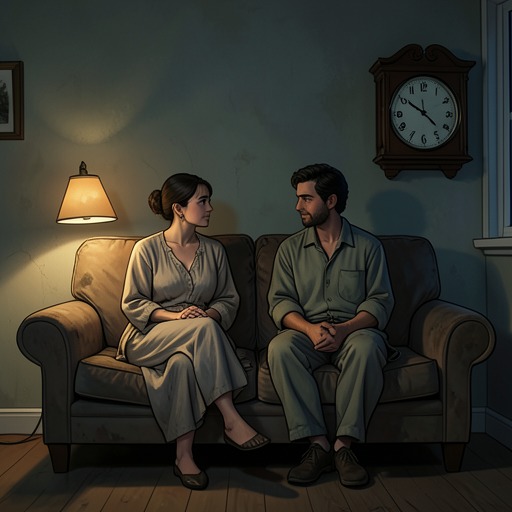
Charlaine and Mike Swain’s marital estrangement
Just One LookCharlaine and Mike Swain’s marital estrangement is shown not through a single rupture but through the domestic habits that have accumulated around it: separate rooms, solitary evenings, and intimacy Charlaine remembers declining. When danger brings them into motion together, their cooperation offers a contrast to that distance, not proof that it has disappeared.
A household divided
Mike is downstairs in the den watching the Yankees on the YES Network; Charlaine is upstairs in the bedroom. They no longer watch television together, and their different tastes and Mike’s handling of the remote are familiar irritations. Yet Charlaine recognizes that these are not the real explanation. She believes she could watch anything. The more consequential fact is that they have settled into separate spaces without her knowing when the arrangement began.
Their children are away that night, taken to a movie by Mike’s brother, but the separation is not limited to the couple. When the children are home, they remain in their own rooms. Charlaine tries to limit their time surfing the Web and reflects on how communication has changed from long telephone conversations among her youthful friends to online exchanges. The household has become, in her assessment, four separate entities in the dark, interacting only when necessary. Her description makes estrangement a family pattern: everyone is present within one home, but shared time and attention have narrowed.
The scene in which she hesitates to warn a police officer sharpens that isolation. The new Pella windows open vertically by hand crank; unlocking and opening them would take too long. She also cannot decide what warning she could responsibly give, or what she knows for certain. She waits. Mike remains downstairs, unaware of what she is considering. Their physical separation shapes the moment, although the evidence does not suggest that their domestic distance causes her hesitation; it shows instead how little of the unfolding danger they initially experience together.
Cooperation, with omissions
When Charlaine sees movement in the Sykes garage, she calls 911 and heads downstairs. Later, Mike drives after the man she has seen. Their suburban development has one true entrance and exit, and its winding roads lead to Hollywood Avenue; the geography gives their pursuit a practical focus. Charlaine fills Mike in quickly, and he listens without interrupting. In this urgent situation, they can coordinate: she supplies what she knows, and he acts on it.
But her account is incomplete. She leaves out why she had been looking out the window in the first place. She recognizes that Mike must see gaps in her explanation, while also noticing that he lets them pass for the moment. The exchange therefore contains both attentiveness and reserve. Mike does not force a fuller disclosure during the pursuit, and Charlaine does not offer one. Their cooperation is real, but it takes place alongside the guardedness that has marked their marriage.
The distinction matters because their crisis response might otherwise look like a simple return to closeness. Mike’s willingness to listen and Charlaine’s ability to rely on him show that the relationship still permits coordinated action. Yet the unspoken part of her story preserves a boundary between them. The danger gives them a shared task; it does not automatically give them a shared understanding.
The loss of shared rituals
Charlaine recalls that she had been with no other man since a particular day, without explaining further what happened on that day. For years, she and Mike returned to a fake Parthenon on their anniversary. That year, for the first time, they did not go. The stopped ritual gives the estrangement a visible measure: an annual return that had persisted for years is now absent. The account does not specify a decision or argument behind the missed visit, so its force lies in the contrast between repetition and interruption.
A memory from two months earlier makes the emotional distance more intimate. At a romantic comedy starring Meg Ryan, Mike reached for Charlaine’s hand. He was moved by romance films, and she remembers that his eyes would fill with tears; in real life, she recalls seeing him cry only once, when his father died. During that film, Mike tried to interlace their fingers. Charlaine shifted her own just enough to prevent it. What torments her afterward is not only the gesture but her remembered indifference: at the time, his reaching out meant almost nothing to her.
That recollection places the marriage’s difficulty in small acts rather than dramatic declarations. Mike offered contact; Charlaine blocked it. The detail gives the later separation a history of missed connection, while her present distress indicates that the memory has acquired a weight it did not have for her then. The text establishes regret about her response, but does not claim that regret alone restores the intimacy she refused.
A tentative change in the present
Later, Charlaine takes Mike’s hand again. The action recalls the movie theater, when he had reached for hers and she had prevented their fingers from joining. Now she remembers that earlier refusal as she makes contact herself. The reversal is small and carefully qualified: it shows a changed gesture and a changed awareness of what the earlier one meant, not a settled reconciliation.
Read alongside their separate rooms, the abandoned anniversary outing, and Charlaine’s omission during the pursuit, the renewed hand-holding remains deliberately modest. It does not erase the years of distance or establish that they have discussed its causes. Instead, it reveals that separation has not made the relationship meaningless to her. The marriage can contain practical solidarity, concealment, old hurt, and a moment of renewed touch at once; its uncertainty is precisely what keeps that gesture from serving as a neat resolution.